
Sudoku
iPhone · iPad · Android
Maze is a game where you guide a firefly through a maze to the exit portal, collecting crystals along the way. Play it offline in Cerebrum, the puzzle games app by Synapgeek, on iPhone, iPad and Android.



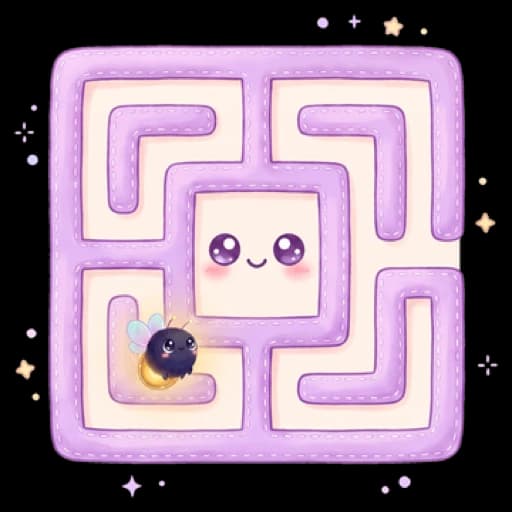
Guide your firefly to the exit portal. Use the on-screen arrows or swipe across the maze: the firefly moves one cell at a time, up, down, left or right, never diagonally. Hold an arrow, or keep your finger down after a swipe, and the firefly keeps walking. Tapping a cell does nothing.
A wall in the way? Just try another direction. Walls stop the firefly and cost you nothing: there are no hearts to lose and no way to fail the level.
Pick up the pink crystals scattered over the board. They are optional, since you can finish without them, but they count towards your stars.
Boosters lend a hand. In a dead end the bubble pops by itself and carries the firefly back toward the nearest unexplored branch that still holds a crystal, or toward the exit when there is none within reach. The rocket sends the firefly off down the corridor on its own.
In Elite the maze is wrapped in fog, and you only see what surrounds the firefly. The overview button shows the whole maze for a few seconds, three times per maze.
A Maze level is a single maze to get through. Each difficulty has its own path of levels, and once you have finished it, Endless Mode keeps going with more mazes of the same difficulty.
Most mazes have a shape, from a triangle on Easy to a heart, a ring, a star or an hourglass on the harder levels, and the cells outside the shape cannot be entered. The others are plain rectangles.
A small maze fits on screen in one piece. In a big one the view follows the firefly step by step, and the overview button zooms out to show the whole board at once, as often as you like whenever there is no fog.
Each star rewards one thing: one for reaching the exit, one for collecting every crystal, one for arriving within the target time, which is worked out from the length of the shortest route.
A five-page tutorial recaps the rules inside the app. The daily challenge never serves an Elite maze, so it never has fog.
Daily challenge: pick Maze and the app sets the day's grid on Easy or Medium, the same for every player.
| Difficulty | What changes |
|---|---|
| Easy | Mazes from 8×8 to 18×18 cells, with no fog, crystals waiting at the end of dead ends and the odd rocket, but no bubble. Open from your first launch. |
| Medium | Mazes from 11×11 to 23×23 cells, still with no fog. This is where bubbles first show up. Open from your first launch. |
| Hard | Mazes from 14×14 to 30×30 cells, with no fog but much longer routes. Opens as you progress through Medium. |
| Elite | Mazes up to 36×36 cells, buried in fog: you see only a few cells around the firefly, and that circle tightens in the latest mazes. Opens as you progress through Hard. |
Nothing more: it stays where it is and you pick another direction. Maze has no hearts and no defeat, so a wall can never make you lose.
No. The timer only matters for the time star: arriving later never loses you a level.
No. Gems are the app's currency, while crystals are picked up inside the maze, and collecting every one of them earns one of the level's three stars. Each crystal also adds to your score.
In Maze you walk: a firefly crosses the board to the exit. Arrow Maze is a relaxing arrow puzzle where you tap pieces to slide them off the board, with no character to guide.
It lights up the next six cells of the shortest route to the exit for about four seconds, starting from where the firefly stands. Under the fog, the hint also reveals those cells for good.
iPhone · iPad · Android

iPhone · iPad · Android

iPhone · iPad · Android

iPhone · iPad · Android

Free to download, with a banner during play and ads between some games. Rewarded ads are always optional. Premium, weekly, monthly or yearly and bought in each store, means no forced ads, plus extra perks. What Premium adds
Updated on