
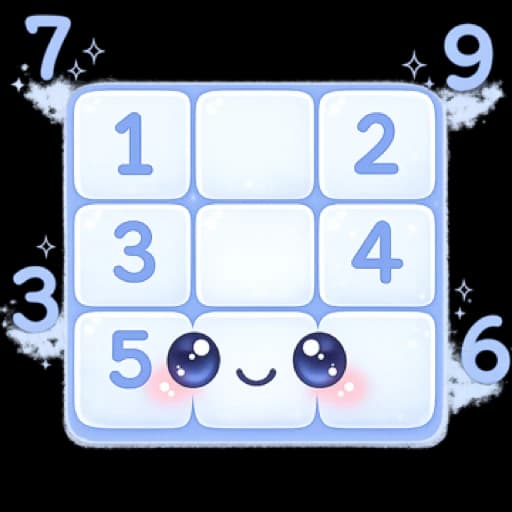
Sudoku
iPhone · iPad · Android
Trace is a one-line path puzzle: draw a single continuous line through every cell of the grid, crossing the numbered checkpoints in order. Play it offline in Cerebrum, the puzzle games app by Synapgeek, on iPhone, iPad and Android.




The goal is to draw one unbroken path that covers every cell of the grid. Tap the 1 to start, then drag your finger from cell to cell: the line moves up, down, left or right, never diagonally. It always starts on the 1 and always ends on the highest number, once every other cell is covered.
Numbered checkpoints are crossed in order: 1, then 2, then 3. The one exception is Elite, where a pair of twin checkpoints can be crossed in either order. Between two numbers the line can wind around as much as it likes, as long as it never goes back over a cell.
Walls, the dark bars between two cells, block the way: the line cannot cross them. It still has to reach all the cells, with none left out.
A wrong turn can be fixed at any time. Backtrack over your own steps, tap a cell on your line to cut it there, or use the on-screen direction arrows. A forbidden move is simply refused.
In Cerebrum, a Trace level strings together three grids, played back to back under a single timer that never stops between them. Each difficulty has its own path of levels, and once you have finished it, Endless Mode keeps the game going with more grids.
Trace has no hearts and no way to lose. A forbidden move, such as crossing a wall, is turned down at no cost: the line stays where it was and you look for another way through.
Only time counts towards your stars: the faster you finish, the more you earn.
The hint reads the state of your line. If you have gone down a wrong path, it takes you back to the last good point; if you are on the right one, it draws the next three cells for you. It plays out step by step on the grid.
The first Easy level also shows a faint ghost trail of the next two cells ahead of your line, to guide your first steps. A five-page tutorial opens the first time you play and can be replayed with the ? button.
Daily challenge: pick Trace and the app sets the day's grid on Easy or Medium, the same for every player.
| Difficulty | What changes |
|---|---|
| Easy | Mostly 5×5 grids, else 6×6, with no walls at all: the place to get the feel of the gesture. Open from your first launch. |
| Medium | Mostly 6×6 grids, else 7×7, with anywhere from none to six walls to steer or block the line. Fewer numbered checkpoints than on Easy, so the line has fewer landmarks to follow. Open from your first launch. |
| Hard | Walls and numbers leave less room for guessing: the line is worked out rather than felt out. Opens as you progress through Medium. |
| Elite | The most demanding grids of the game. Opens as you progress through Hard. |
No. Trace has no hearts and no defeat: a forbidden move is refused without an error, and you carry on. Only the time affects your stars.
Every cell. The numbers set the order of the stops, except for the twin checkpoints of Elite, but the line must cover each cell of the grid, once and only once.
In one of three ways: retrace your steps, tap a cell on your line to cut it there, or use the direction arrows.
It adapts to your line: a return to the last good point if you are off track, three more cells otherwise.
Each level is a series of three grids to finish back to back, with a timer that runs without a break. Stars are judged on time, not on how many attempts you needed.
iPhone · iPad · Android

iPhone · iPad · Android

iPhone · iPad · Android
iPhone · iPad · Android
iPhone · iPad · Android
Free to download, with a banner during play and ads between some games. Rewarded ads are always optional. Premium, weekly, monthly or yearly and bought in each store, means no forced ads, plus extra perks. What Premium adds
Updated on